Mixed Messages
Written by Sam Cornish
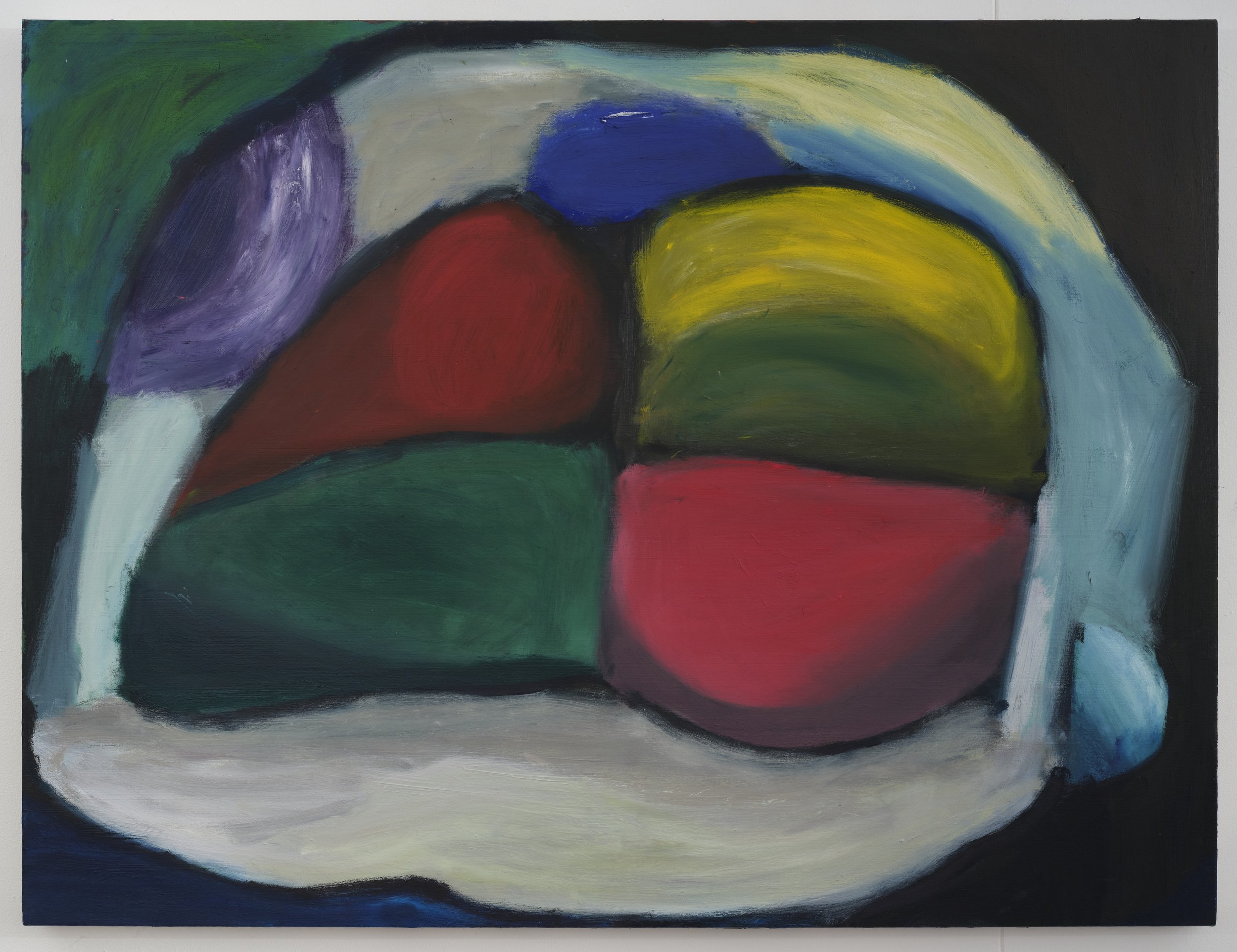
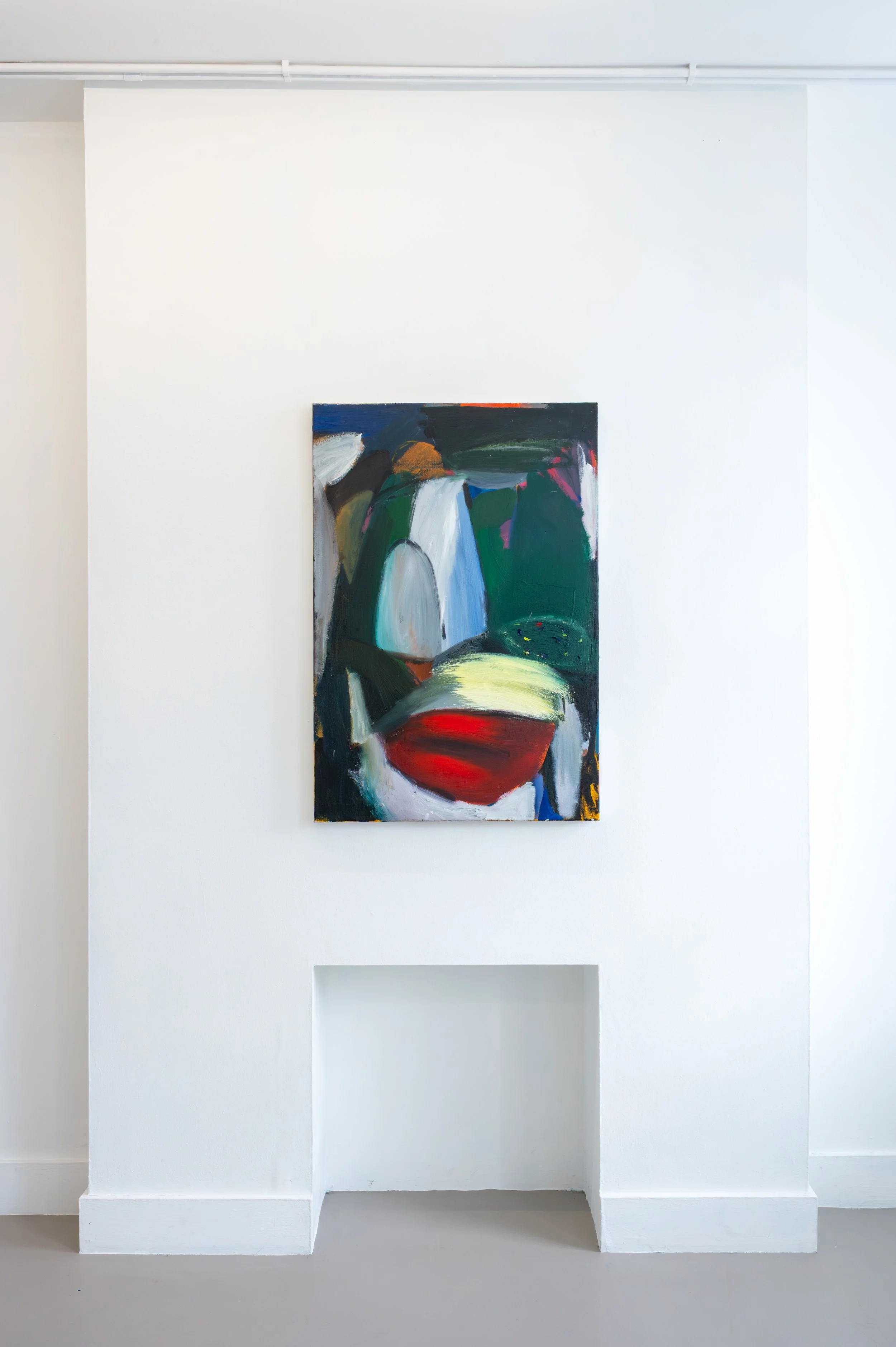
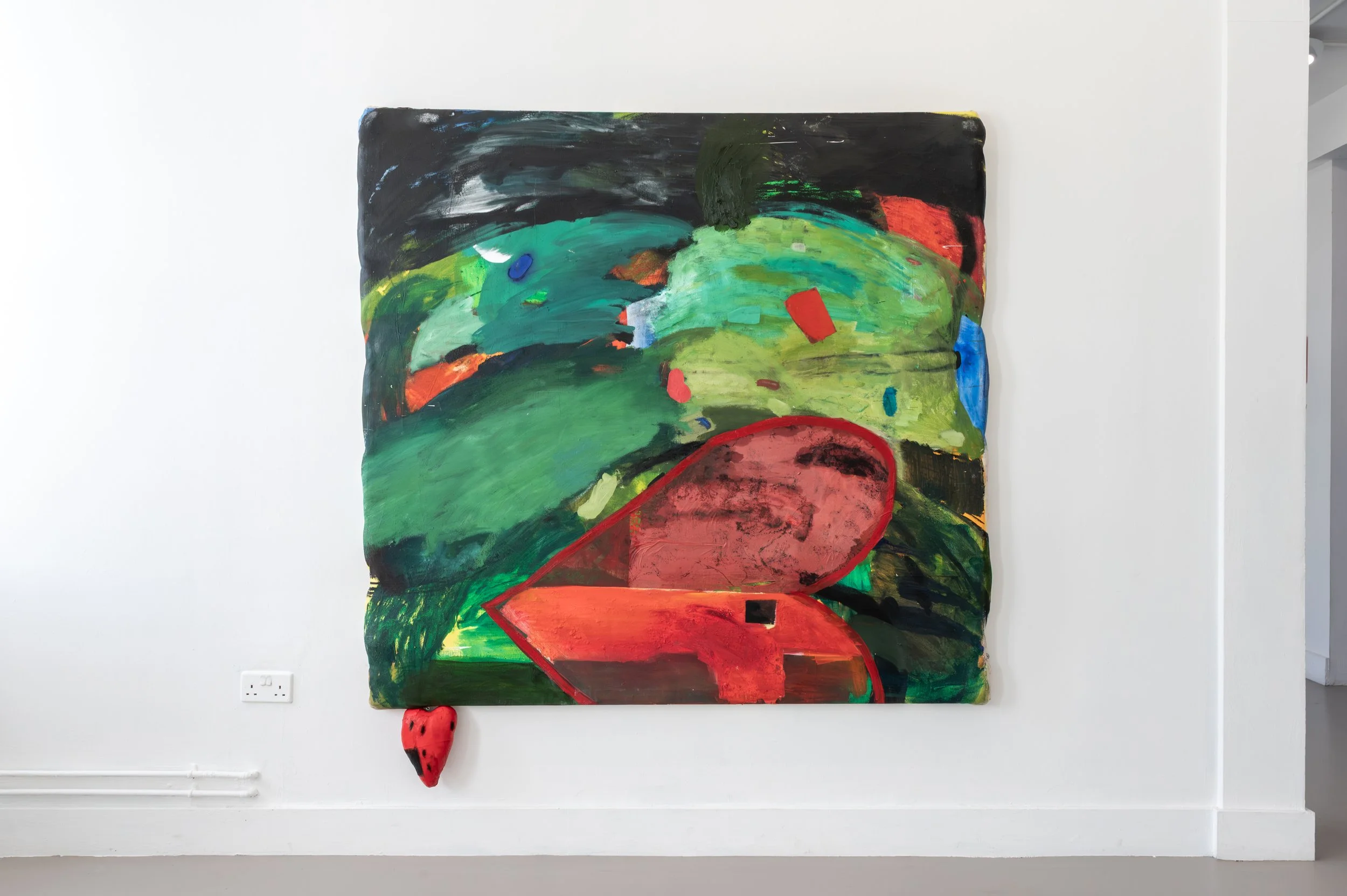
Yasmine Robinson’s art is a kind of juggling act. The objects involved are ambiguous, with slippery identities, liable to change. Suggestions of a pair of lips, an orange, a hillside, a wonky starfish, a set of upright standing stones, appear alongside elements more fully abstract, or at least less nameable. The game she plays with these objects, to mix metaphors, is a little like hide and seek. Her images are bold and joyful, even naive in their presentation, but looking slightly longer there is always something withheld, a space glimpsed which her crowds of objects prevent us fully seeing. This denial acts like an invitation, an encouragement to keep looking, but it also enriches her paintings with a sense of unease. As she said to me while we were looking at the work to be included in this exhibition, “there is always some part of yourself that is unknowable.”Part of their slipperiness is to do with scale. We might think we are dealing with something as large and distant as a landscape or as close and intimate as a still-life. Or perhaps what we see is a landscape shrunk so it is almost (never quite) within our grasp, or a still-life whose constituent elements have been inflated, made monumental. Reality and directness are often combined with the sense that the objects she describes have been pumped-up, into dream-like, air-filled absurdity. Emojis are a source for some of Robinson’s motifs, including the hearts in her earlier painting Fruitshop (2022). This painting reminded me of the video for Roger Sanchez’s Another Chance (2001), where a young woman’s search for love is externalised in form of an expanding and deflating heart, that she awkwardly carries around New York. Robinson’s images move in the opposite direction, subsuming external, partly pop-cultural cues within the clutter and shadows of inner feeling. How do we navigate our emotional responses using the images the contemporary environment provides us with?The same mixed messages apply to the paintings’ ambiguous sensuality. This is overtly signalled by the lips (another emoji-motif) that appear in Selfie Graveyard, Stone Lips and Duckworthbut found is more generally across the paintings as a group, in their hidden spaces and their closely packed, curving forms. Robinson is highly aware of the demands placed on women to package their physicality, to limit it, make it attractive and contained within convention. Painting here is perhaps in part an escape into another, more fully realised, less regulated sense of physicality, even as they acknowledge the wider situation they move away from.Over the last few years many of Robinson’s paintings have been literally inflated, the canvas stuffed with wool, so that their edges and surface push beyond the picture’s traditional flatness. Inner Ears, the oldest painting shown here, is a good example. Its bulging front is covered with shapes that are sometimes just swipes of impasto paint, sometimes forms simplistically modelled with light and shade, and in one instance, a piece of canvas collaged onto the surface. The point is not, I’m sure, to advance an academic argument about contradictory languages of illusion in painting, but to use this contradiction to provoke a feeling in the viewer, even if this feeling’s identity is itself hard to pin down. In her new paintings, Robinson has moved away from the stuffed canvas. She thinks it restricted the ability of the viewer to move around her paintings’ spaces. The larger new paintings have a new confidence in their image-making, although for me some of the smaller works are the most compelling, with their subtler, sometimes silvery colour, and more distanced, more fully contained forms. Looking at Selfie Graveyard or Stone Lips, after time spent with the brash colour of paintings such as Moon River or Silver Lining, I noticed my eyes adjusting, as if I have moved from a bright outside into a twilight room.As with many painters today, Robinson has a personal engagement with the history of modern painting, a sort of pick and mix canon, that she does not necessarily share with her immediate peers. John Hoyland is important to her, particularly his referentially ambivalent paintings of the 1980s, as are the quasi-figurative abstractions works of Howard Hodgkin, his earlier painting in particular. Perhaps more crucial is the example of early twentieth-century expressionists such as Gabriele Munter or, especially, Alexej von Jawlensky. These artists, with their near prismatic colour and roughly hewn, simplified forms, come from a moment when a language of abstract art was being formed and had not yet evolved into fixed positions. I think the non-dogmatic flexibility this offers is part of the attraction to Robinson, as is their beguiling mix of the prosaic and the otherworldly.
Sam Cornish is a writer and curator, with a particular interest in abstract painting and sculpture. He is co-editor of the catalogue raisonné of John Hoyland's paintings on canvas. His publications include Frank Bowling: Sculpture (Ridinghouse, 2022), John Hoyland: The Last Paintings (Ridinghouse, 2021), Mali Morris: Painting (Royal Academy, 2019), Stockwell Depot 1967-79 (Ridinghouse, 2015), John Panting: Sculpture (Sansom & Co, 2012). He curated or co-curated the exhibitions Frank Bowling: Sculpture (University of Greenwich Galleries, 2022), John Hoyland: The Last Paintings (Sheffield Museums, 2021), Kaleidoscope: Colour and Sequence in 1960s British Art (Arts Council touring exhibition, 2017-18), and John Panting: Spatial Constructions (Adam Art Gallery, University of Wellington, 2013).
https://www.ccadld.org/exhibitions/glimmers
Glimmers at CCA Derry~Londonderry 2026